
The problem
An instrument produces a file, but a person still has to connect it to an operator, a review, and the records needed later.
Regulated work needs a clear record of who did what, when, and with which instrument output. The GIMS Compliance Relay captures that evidence as the work happens.
Instead of relying on handwritten records to connect instrument files, operators, and approvals, the Relay watches an export folder, records new files, and links captures, reviewer access, signatures, and exports in one ordered trail.
Active pharma pilot21 CFR Part 11FastAPI · Tauri · Postgres or SQLiteAn instrument produces a file, but a person still has to connect it to an operator, a review, and the records needed later.
File capture, attribution, electronic signatures, and sealed exports share an append-only record stream with verifiable integrity.
Reviewers can follow the evidence and re-verify exported records offline. The controls support regulated workflows without making staff reconstruct the history by hand.
The two-tier design separates the instrument edge from the server of record. Keyed HMAC chaining makes changes detectable; identity, signature, and export events share the same trail. The implementation addresses record integrity and traceability in a 21 CFR Part 11 context. The engineering report documents the controls and their verification.
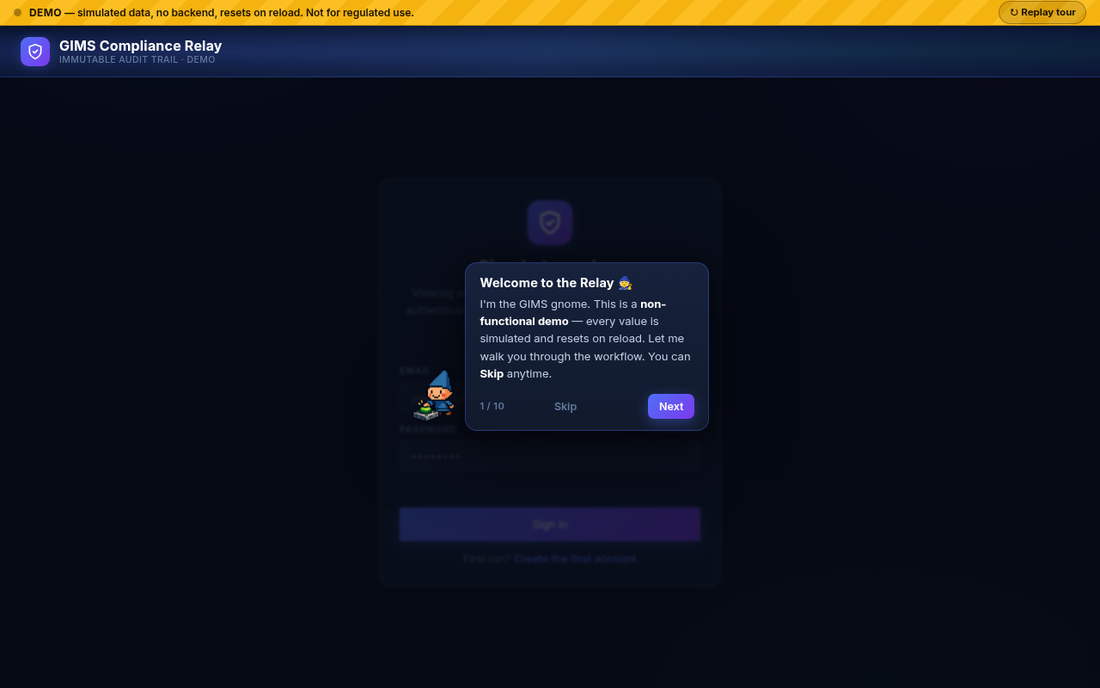
Viewing the regulated trail needs an authenticated reviewer. The tour fills in a reviewer’s email and password, and from there each step performs the real action through the mock, so the trail visibly grows the way the live product’s does.
The demo is a static site: no server, no serverless function, no build step. It shows what the product does, not how. The mechanisms that make the real product defensible are deliberately not present in it.
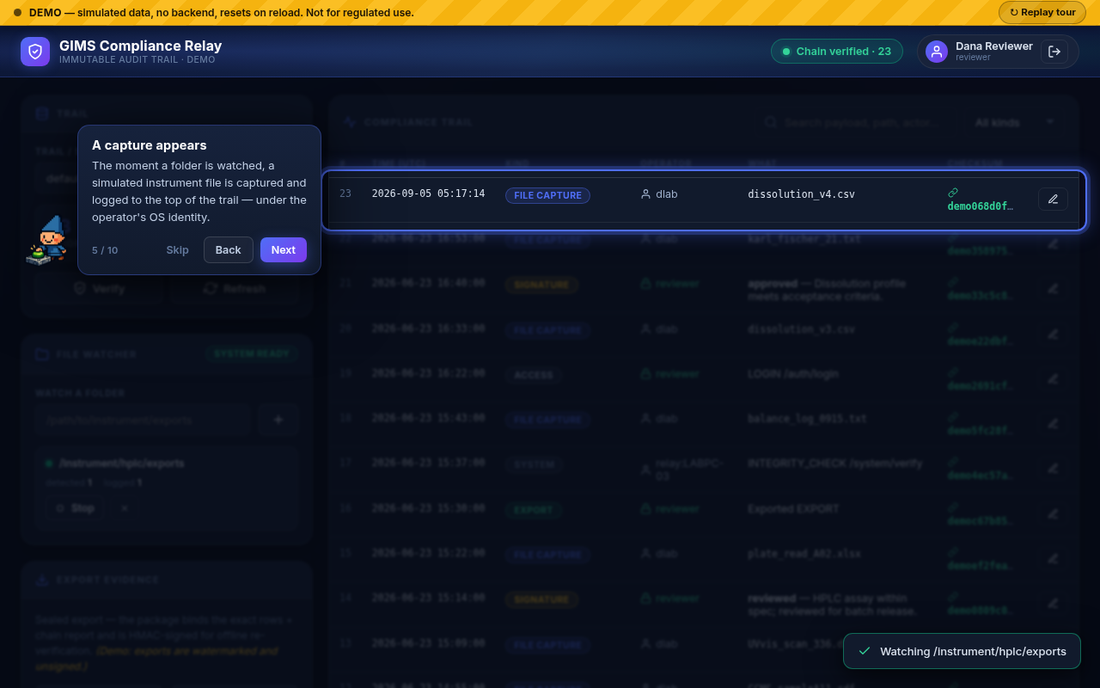
A trail is a study or batch, its own append-only record stream. The tour points the relay at /instrument/hplc/exports. The moment a folder is watched, a simulated instrument file is captured and logged to the top of the trail, under the operator’s OS identity: kind, operator, what, checksum.
Then Verify. In the real product this re-walks a keyed, tamper-evident chain; in the demo it is cosmetic, and the header pill turns green.
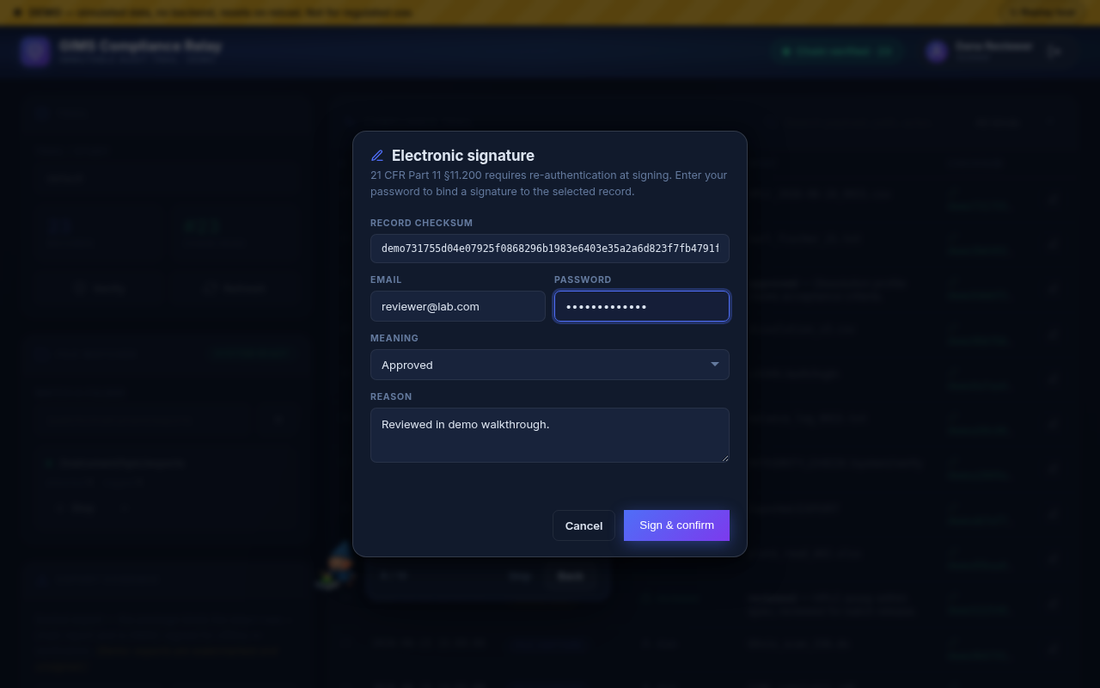
Reviewers bind an electronic signature to a record. Part 11 requires re-entering your password to sign, so the dialog asks for it again, with a meaning (approved, reviewed, rejected) and a reason. The signature lands on the trail as its own record, linked to the one it signs.
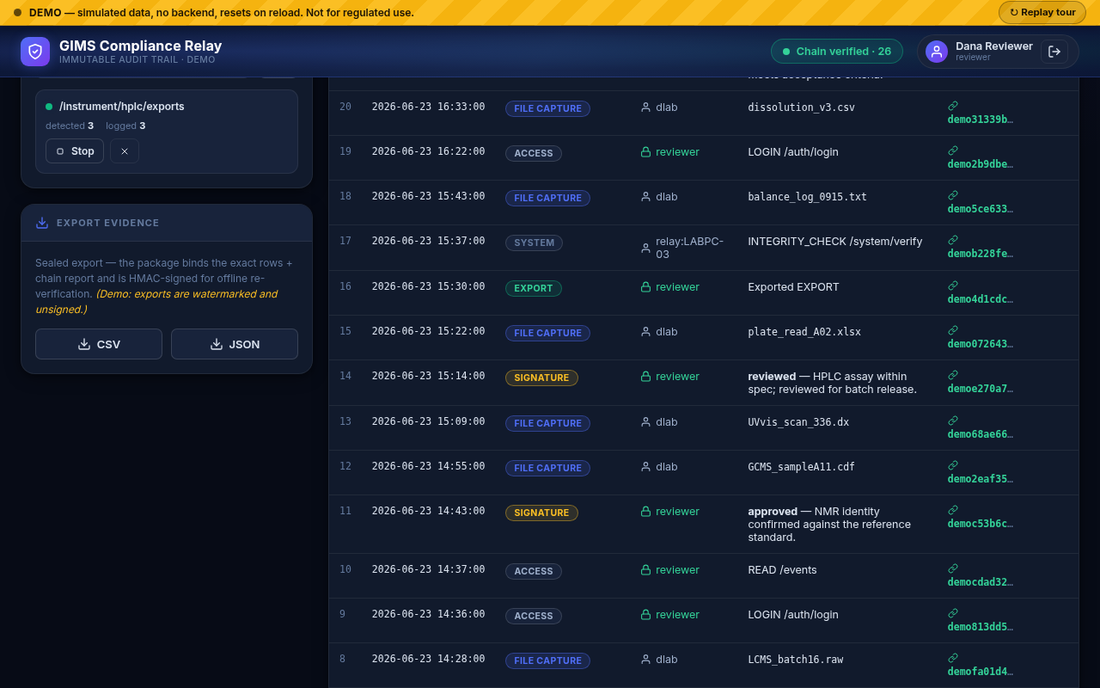
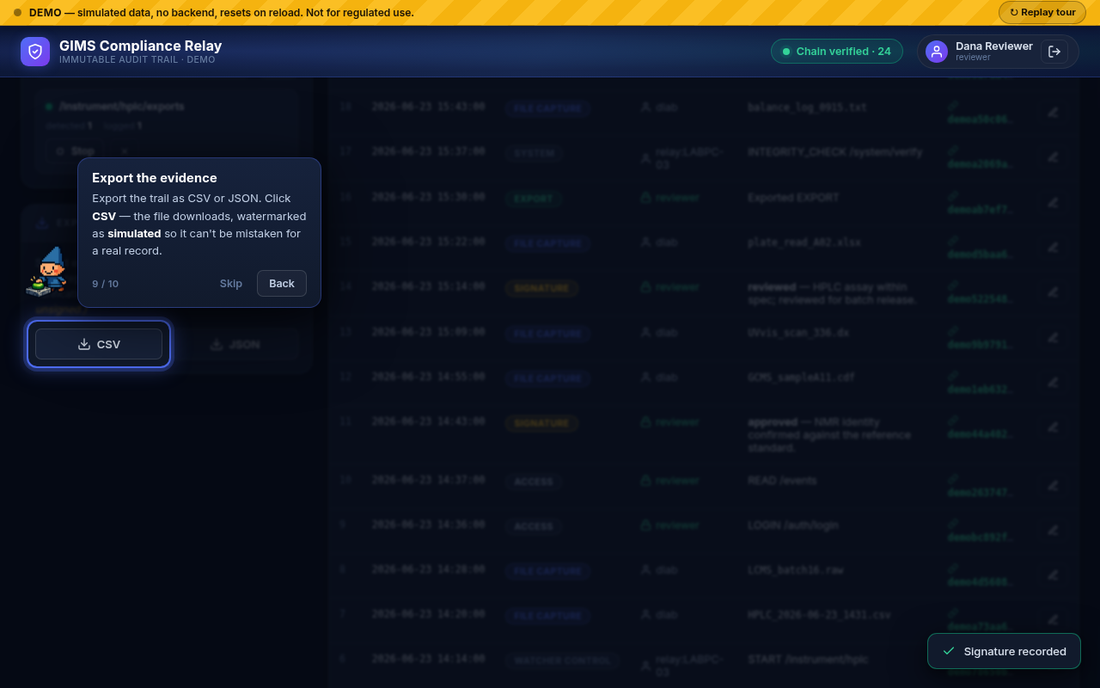
The production product exports a signed evidence package that an auditor can re-verify offline, without access to the live system. The demo’s exports are watermarked as simulated so they cannot be mistaken for a real record.

A ground-up rebuild of a copy-paste-grown FastAPI + Tauri app, whose compliance guarantees were largely decorative, into a lean, defensible Part 11 logging service: one append-only HMAC-chained trail, non-forgeable attribution, real two-component e-signatures, provider-neutral storage, and a two-tier edge → server-of-record custody model. Then a second pass that closed the twelve lagging §11.x edges the design described but the code had not yet delivered.
The constraint that shaped it: Part 11 defensibility first. The integrity spine was hand-built and hand-tested; breadth was built by multi-agent workflows; and every claim of “this control actually holds” was put through an adversarial verification pass whose only job was to refute it. That pass is how the two deployment-breaking bugs in the report were caught before shipping.
The Relay is in an active pilot with a pharma company. It is built to a real regulatory standard rather than a generic audit log; the compliance detail is the product. The stage it is at: a demo that shows the workflow, a defensible core that has been adversarially verified, and a live sales conversation, being pushed toward a first production deployment.
Show me one task your team does by hand. In 20 minutes, I’ll tell you if it’s worth automating and what it would cost.