The GIMS gnome
Evan Brown
Systems / Solutions Architect

Workflow automation for small offices

Keep copy and paste
out of your vacation.

I hate copying data from one system to another, and in a small business it’s often the owner’s job, so a vacation turns into catch-up work. I set it up so it moves on its own and you get to breathe.

If someone in your office types each job into your scheduling app and then again into QuickBooks, I set it up so the job shows up there on its own, and your office person just checks it.

At an insurance agency it’s the same with the rater and the agency system.

It’s free and takes about 20 minutes, and if automating it wouldn’t pay off, you’ll know that before you’ve spent anything.

Evan Brown · GIMS Technologies · Highlands Ranch, ColoradoIn person around the Denver south metro · remote anywhere
The job you type twiceIf any of this sounds familiar

In a lot of offices, someone types the same customer into two systems that don’t talk to each other.

The programs may each work fine on their own, and the time goes into getting the same information from one into the other by hand, then cleaning up when the two don’t match.

  • “The job goes into the field app, and then I type it into the books again.”

    Then someone fixes the duplicate customers and matches the app’s payments to the bank deposits, all by hand.

  • “Every new client goes into the rater, and then again into the agency system.”

    Policies that don’t download get typed in by hand, and so do endorsements, certificates and the commission spreadsheet.

  • “What clients put in the portal, we type again into the tax program.”

    Then someone spends tax season emailing clients for the documents they still owe.

If only one person knows how your numbers move between systems, the numbers stop when that person’s out. I turn what they know into steps a system runs, so the numbers keep moving and that person just checks them.

A familiar example

A weekly report nobody has to chase.

  1. You provide the contextSay what the report is for.

    You pick the reporting period and the question it needs to answer.

  2. The system handles the routineIt gathers and checks the numbers.

    It pulls the data, applies your rules, flags anything odd and drafts the report.

  3. You make the callYou look it over and approve it.

    It’s the one step that still needs you.

Once it’s set up, the report goes out even when whoever used to build it is on vacation.

Illustrative workflow · the principle behind my work

Offers and pricesFixed prices, agreed before any work starts

Four things I do, with the price of each.

Every job starts with the free 20-minute check, which is also where we set the exact price if you decide to go ahead. Every offer in full

  1. Free 20-minute check

    The way in, for every offer

    Bring the one job someone in your office keeps typing into two systems, and I’ll tell you whether it can run on its own, what it would cost, and whether it’s worth it.

    Book a free 20-minute check
    Free20 minutes
  2. Fix one workflow

    For an office that types the same job into two systems

    I set up one of those jobs so nobody has to type it twice, at one fixed price for the work. It’s working in two weeks, you keep the software you already pay for, and you own it.

    If that’s more than you want to take on right now, there’s a $500 first step that’s credited toward the full job.

    Fix one workflow in full
    $1,500–3,000Fixed price · half up front
  3. Second Brain Install

    For consultants, solo attorneys, agency owners and coaches

    After a client call, the follow-up is already drafted from your notes and waiting for you to approve or fix, so it doesn’t depend on you remembering it at 9 pm.

    Second Brain Install in full
    $750For the first three clients, then $1,500
  4. Vibe Code Audit

    For apps built with AI

    If you built an app with Lovable, Bolt, Replit, Cursor or v0, the Launch Check goes through the five things that tend to go wrong once people start using it, and the Rescue Sprint fixes whatever it finds.

    See the Vibe Code Audit
    $299Launch Check · credited toward any fix$1,500–2,500Rescue Sprint · fixed
How the free check worksAbout 20 minutes, on a call

All you need to bring is the job you want off your plate.

There’s no plan or spec to write first, so just pick the job that takes up the most of your team’s week.

  1. Before the call

    Tell me which job it is.

    A line or two is enough, like which two systems it goes between, who types it and how often.

  2. On the call

    Show me how it’s done today.

    You walk me through it the way your team does it now, and I ask questions as we go.

  3. By the end

    Hear what I’d do about it.

    I’ll tell you what I’d build, how long it would take and what it would cost, or why I’d leave it alone.

Book a free 20-minute check

After that it’s up to you, and if you decide not to go ahead, the advice is yours to keep.

Who does the workHighlands Ranch, Colorado

You talk to the person who builds it.

I’m Evan Brown, and I run GIMS Technologies out of Highlands Ranch, Colorado, on my own. The person you talk to at the free check is the one who builds it and checks it before it goes live.

I work in person around the Denver south metro, in Highlands Ranch, Littleton, Lone Tree, Centennial, Englewood, Parker and Castle Rock, and remotely with anyone, anywhere.

More about me
For apps built with AILovable · Bolt · Replit · Cursor · v0

An app can work fine in the demo and still leave its data open.

Moltbook went viral in January 2026 with its database open to anyone. Wiz counted 1.5 million API keys, 35,000 email addresses and thousands of private messages anyone could read, all because one setting was off. Wiz’s write-up ↗

That setting is the first thing my data access check looks for. Before you launch, or before a lot more people sign up, the Launch Check goes through five things:

  1. Logins
  2. Keys
  3. Payments
  4. Data access
  5. What happens when something fails
For hiring teams & engineersThe engineering, one tap away

Hiring?
The engineering is below.

My work makes information flow, traceability, and failure handling explicit. I’m increasingly focused on data engineering environments where throughput, reconciliation, recoverability, and orchestration become central concerns.

Below: a thirty-second showreel, results from the lab work, and the projects, each with a path into the architecture.

ShowreelThirty seconds. Sound is optional.
Showreel · the thesis, the principle, the evidence and the projects, drawn from this site’s own screens and copyPlay it, with or without sound
Evidence from the workEquilibrium Scientific · laboratory validation
From a full day or more to~1 hour.Chemistry validation analysis

Faster answers, when the next decision can’t wait.

I designed validation architecture to process LC-MS, GC-MS, and ICP-MS data. Analyses that could take a full day or longer took roughly an hour, giving early-stage labs faster feedback on whether to retest, revise a method, or move forward with a validation report.

The laboratory work behind the software
7 jurisdictions
Compliance systems delivered
10+ testing categories
Validation packages accepted by state auditors
~20 minutes
Bio-Techne pricing reconciliation, down from multiple hours
Selected projectsRecognize the problem. Explore the engineering.

The systems behind
the better workflow.

Working software, real screens, and the decisions underneath. Each project has a quick introduction and a path into the architecture.

01 / Data & workflow infrastructure

GIMS

When the real workflow outgrows the spreadsheet.

Rigid software leaves people managing the gaps in side files and workarounds. GIMS makes the actual process explicit: structured records, configurable workflows, and a foundation that reporting and automation can reuse.

Why it matters The process can evolve without rebuilding everything around it.

Open-source core

Python · FastAPI · SQL · React

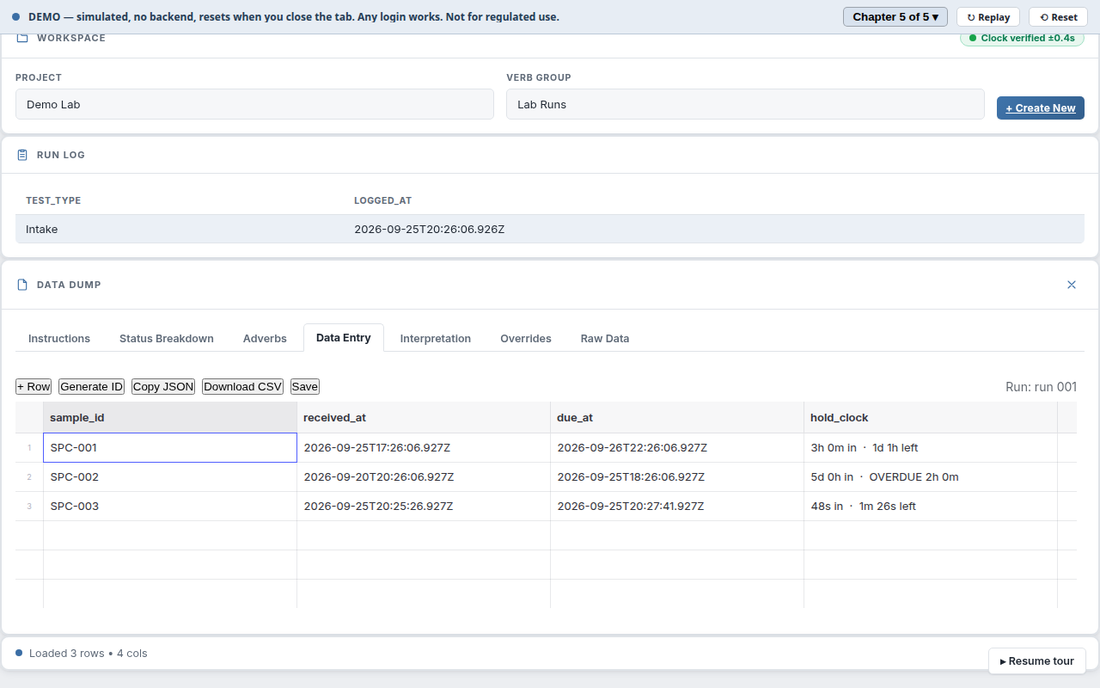
Inside GIMS · a run log tracks samples, timing, and results.
Real interface · simulated demo data
Record integrity & traceability

GIMS Compliance Relay

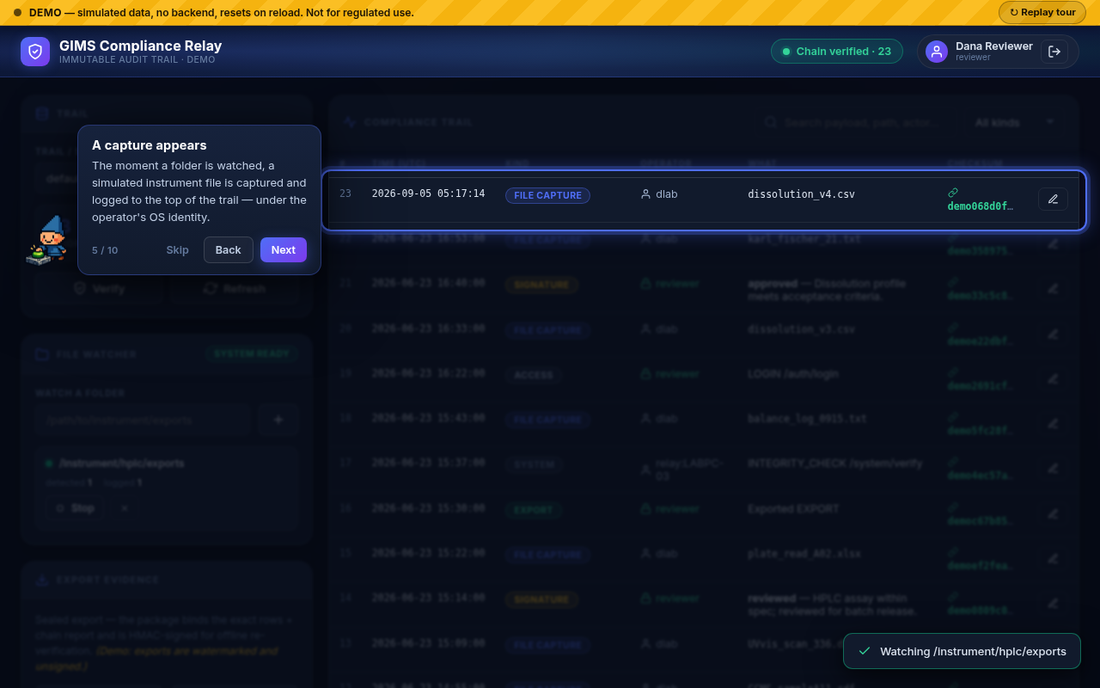
A result is only part of the story. The Relay captures instrument files, records who did what, and packages evidence for review—so a lab can reconstruct how the work happened.

Why it matters Less handwritten recordkeeping; a traceable record reviewers can check.

FastAPI · Tauri · PostgreSQL · HMAC integrity

Explore the controls & demo
Instrument capture → audit trail · simulated demo
Development workflow & orchestration

GUTS & the development workflow

I wanted to run more work than I could personally keep in working memory. A shared coordination layer connects parallel agents, records their work, and brings decisions back to me.

Why it matters Long-running work stays organized and accessible across devices.

Agent coordination · MCP · RAG · tmux · Tailscale

See the architecture
An explicit path for the work
Human intent ↓ Coordination ↓ Agents & tools ↓ Recorded work ↓ Human review
Shared memory. Visible decisions.
Database computation & correctness

autoSQL

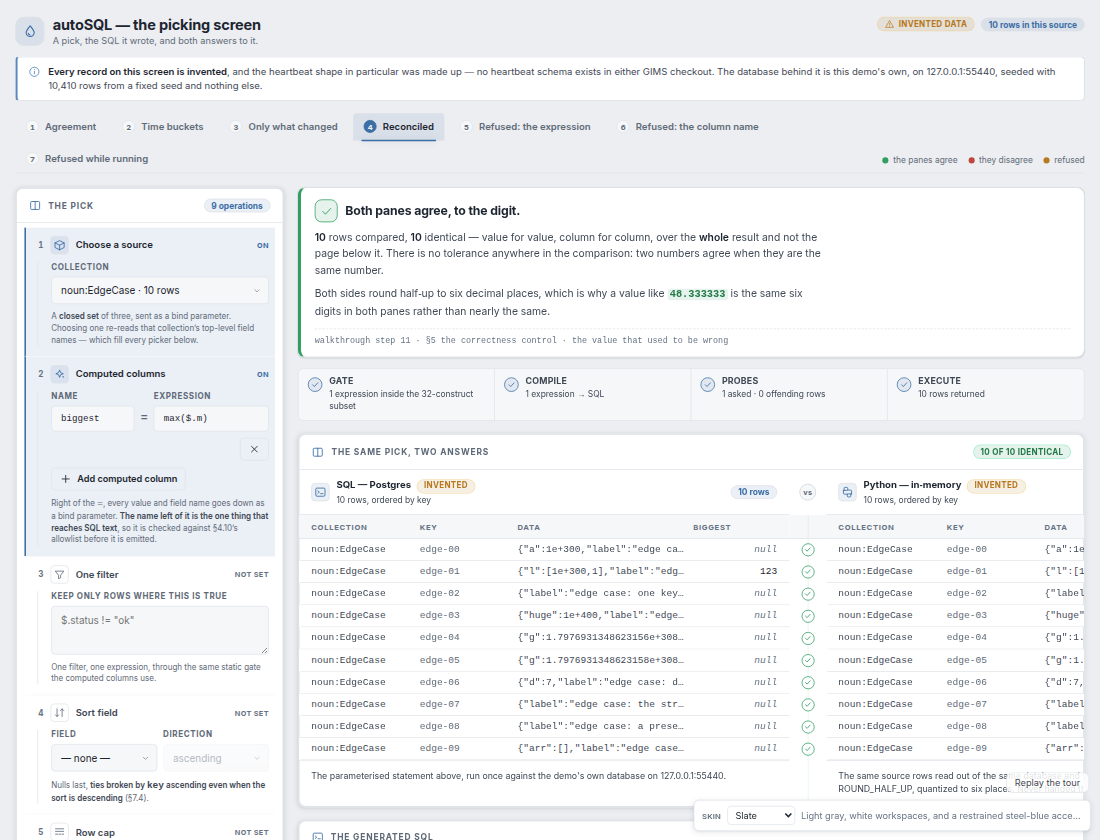
Moving data out of a database just to reshape it creates another bottleneck. autoSQL compiles a user’s selections into SQL that runs where the data lives, then compares results against the Python path.

Why it matters Numerical disagreements become visible. The performance question stays measurable.

Python compiler · PostgreSQL · generated SQL

Explore the design & evidence
Two engines, one comparison · every row checked

What does your team
still copy and paste?

If a job like that comes to mind, book the free 20-minute check and we’ll go through it together.