The GIMS gnome
Evan Brown
Solutions Architect  ·  Full-Stack Systems Builder  ·  M.S. Microbiology
Systems Builder · Lab Informatics · Technical Implementation
Codebase tooling · repo-tour and Build Tutorials · one suite, one core

Be walked through a repository instead of opening it cold.

Point it at a codebase you have never seen. It reads the whole tree, works out which few files actually carry it, and builds a guided tour, the system first, then the code, with the reasoning written by reading the lines it points at.

You can read code faster than you can be given time to read it. Handed an unfamiliar repository, a new job, an acquisition, a dependency you now own, a pull request against 1,500 lines you did not write, the honest options are to spend a week, or to skim and hope. Most review is the second one, and “LGTM” is what that sounds like. The hard part is not reading a file. It is not knowing which forty of four thousand files to read, or in what order. repo-tour answers that question first, and only then starts explaining.

AGPL v3 or laterTypeScript · tree-sitter · Claude, Codex, or a local Ollama model
How it works five stages; everything cheap and exact runs first

Four are deterministic and free; exactly one spends tokens, and it runs last, by which point the field has been narrowed from thousands of files to a handful.

That ordering is the whole design. Everything cheap and exact runs first so the expensive stage only ever reads what survived. The paid stage sees only the tour itinerary, around six files out of however many you have, and every explanation is cached by content hash. A first tour of a 365-file repository is a handful of calls; a rebuild after editing one file re-does one file’s worth of work.

./repo-tour providers      # what can run here
./repo-tour doctor         # node, git, parsers, providers
StageWhat it doesCost
1 · InventoryWalks the tree. Every nested .git is its own repository with its own history. Classifies each file from deterministic signals only: linguist markers, path patterns, generated headers, lockfile names.free
2 · RankChurn, import in-degree, and, last, size. The order matters: on a real repo the five largest files are usually build exhaust, and the most important one is 96 lines.free
3 · Extracttree-sitter. Symbols, imports, call sites, public surface. A parser cannot invent a function that does not exist.free
4 · InterpretA model reads the actual lines and writes what they do and why. The only stage that spends anything.tokens
5 · Roll upFiles → directories → subsystems → repo, each tier written from the tier below. No step ever needs the whole repo in context.free
What you get real screens from a local run and from stored tours
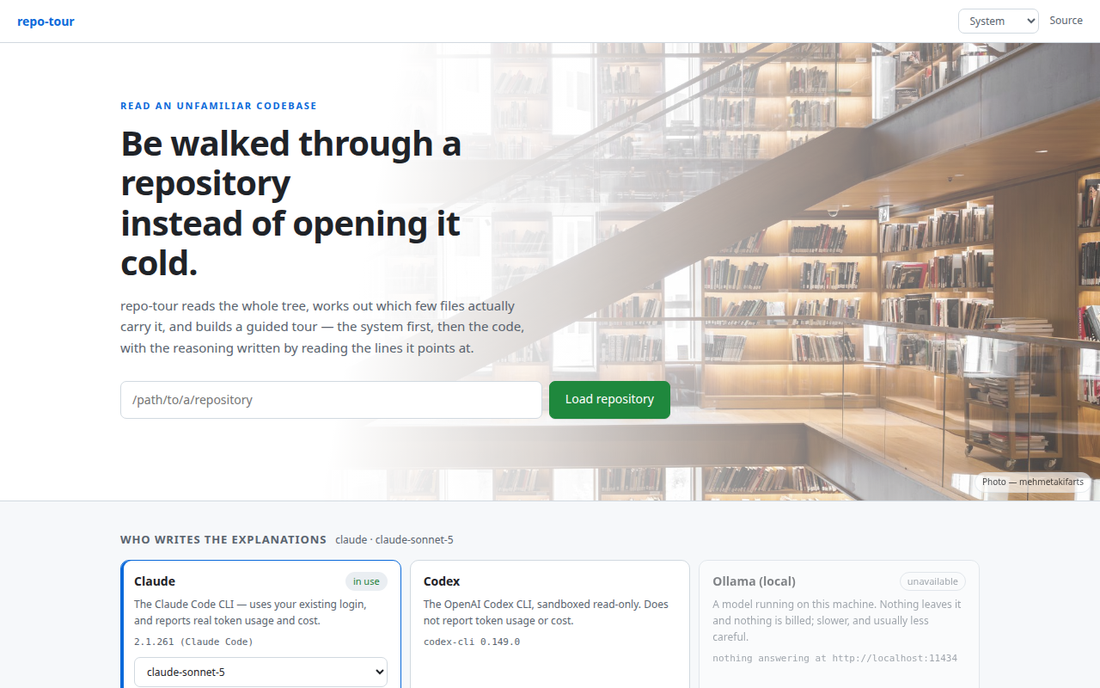
repo-tour's start screen from a local run: the headline Be walked through a repository instead of opening it cold, a path field with Load repository, and the provider picker showing Claude in use, Codex, and Ollama unavailable
http://127.0.0.1:7788 · a local ./start.sh runthe front door; the photo on it is repo-tour’s own, credited there

The app

Load a repository, press Build the tour, and read. Repositories stay loaded; refreshing a tour re-reads the repo, so what you are looking at is the code as it is now. Which model writes the explanations is a setting, picked on this screen, not a hardcoded binary.

The system before the code

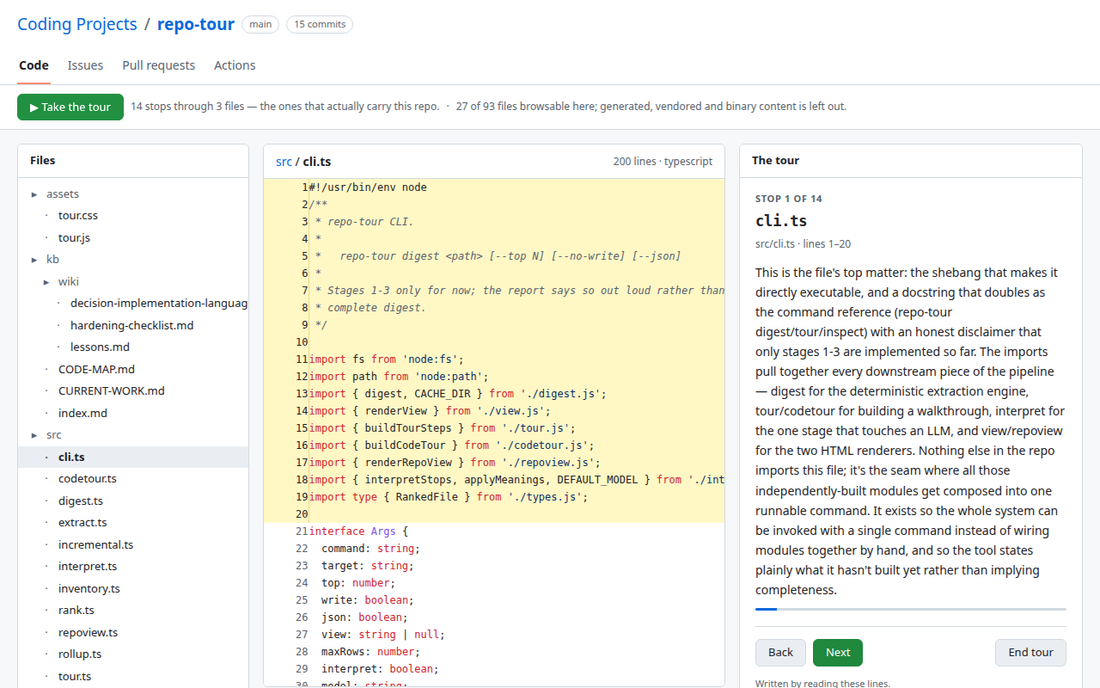
A diagram of the parts, which way imports flow between them, and one stop per part, then it descends into functions. The contents are visible before you start; begin at any chapter, skip one, jump back. This is repo-tour touring itself: 14 stops through the three files that actually carry the repo, and stop 1 is cli.ts, with the explanation written by reading the lines it highlights.

Honest limits, on the page: the import graph states its own coverage, the digest says which stages ran, and a tour built before your last commit says so in the corner rather than disappearing.

A repo tour of repo-tour: the file tree, cli.ts with its first twenty lines highlighted, and the tour panel at stop 1 of 14 explaining the file's top matter
repo-tour/.repo-tour/view.html · repo-tour touring itself, stop 1 of 14a stored tour, opened offline
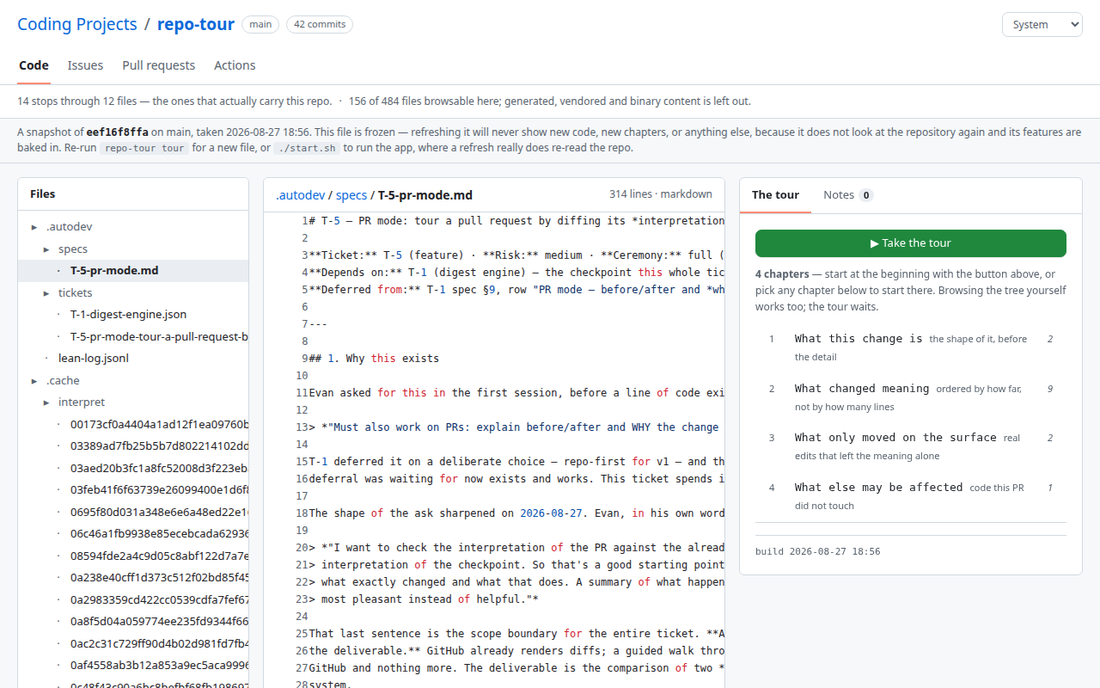
A pull-request tour: 14 stops through 12 files, a frozen snapshot note, and four chapters: what this change is, what changed meaning, what only moved on the surface, what else may be affected
repo-tour/.repo-tour/pr-cb207c56.html · a PR tour, four chapterswhat this change is · what changed meaning · what only moved on the surface · what else may be affected
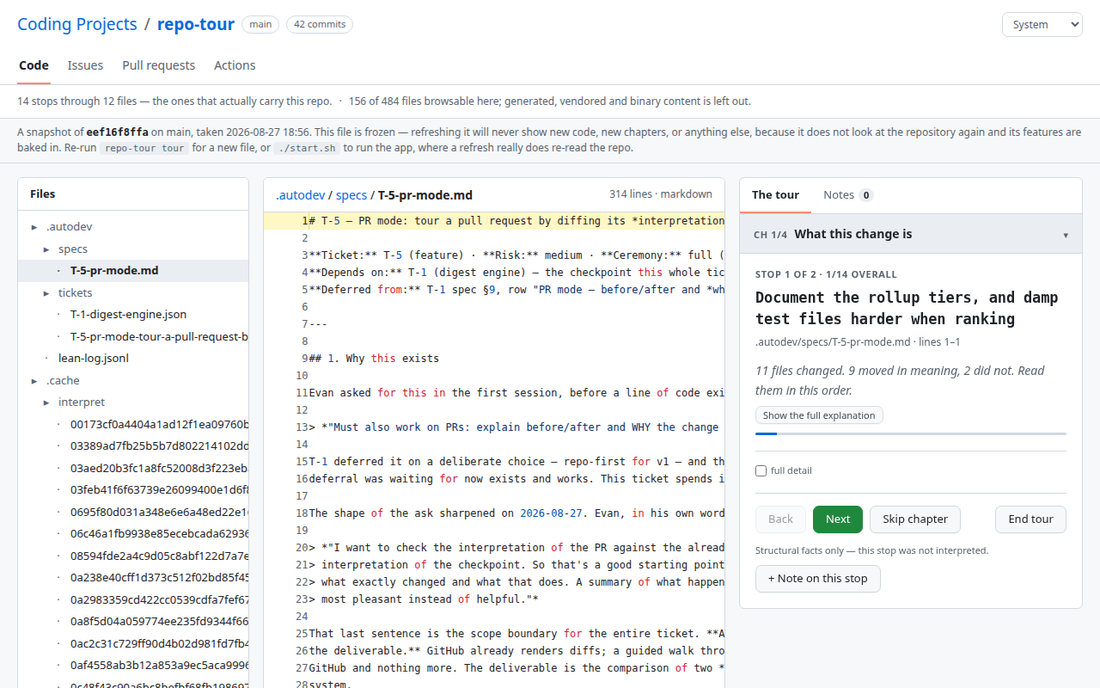
The same PR tour at chapter 1, stop 1 of 2: Document the rollup tiers, and damp test files harder when ranking; 11 files changed, 9 moved in meaning, 2 did not
repo-tour/.repo-tour/pr-cb207c56.html · stop 1 of 1411 files changed; 9 moved in meaning, 2 did not

PR mode: what changed, and what it means

./repo-tour pr <number> tours a pull request. It compares the change against the digest you already have, the checkpoint, so it can say which files moved in meaning and which only moved on the surface. Nothing is ever checked out; only the changed files are read out of git.

Notes with provenance

Take a note at any stop and it records which explanation prompted it. Export as Markdown grouped by file. That is a review comment; “LGTM” is not. A tour also exports as a single self-contained file that opens offline, the whole repo page, the tour, and the notes panel, with no network at all; the two tours above were opened exactly that way.

Build Tutorials the inverse: how the repo got built, one decision at a time

A paint-by-numbers tutorial, generated from a real repository, that walks you through building it. Not just reading it.

repo-tour digests a finished repo and explains how it works; this is the inverse: it explains how the repo got built, one decision at a time, and then has you build it yourself. It is a VS Code extension, and the two share one core: the extension loads repo-tour’s ESM package, unbundled, from inside the extension host.

What is here right now is the extension skeleton and its doctor, the start screen, the shared skin contract, and building the plan with resume. There is still no decision tree, no step panel, no tutor; those arrive in the next tickets. There is no screenshot of it here yet, because it runs inside VS Code’s extension host rather than in a browser; the repository is the honest place to look.

Every webview inlines repo-tour’s own stylesheets unchanged, plus a small bridge sheet that maps its tokens to VS Code’s theme variables. Pick System and the page follows your editor’s colour theme in real time; pick a named skin and it looks the same here as on repo-tour’s pages. Adding a skin is still one CSS file plus one row in a registry; nothing in the extension has to change for it to show up.

The start screen asks
  • What do you want to build? an idea, in your own words
  • Just recreate the repo as it stands the only mode v1 actually builds; idea-first builds arrive later, and the form says so under the field rather than declining silently
  • Reference repo a local path, or a GitHub URL cloned in full because the witness needs history; only languages the shipped grammars cover, named when refused
  • Build it in an empty or new folder, where the plan and later the tutorial live
  • How much do you want to type? manual, scaffolded, or automated
Building the plan
  • Runs behind a cancellable progress notification with a write-ahead marker; if the window reloads mid-build, the next activation offers to resume, and every finished step is cached by content hash
  • On success the plan lands at .repo-tour/build/plan.json and a notification reports chapters, steps, and the cost, or an honest “this provider does not report usage”
  • The test suites never spend a token; the one run that asks a model anything is the acceptance pass on a real target repo
Licence, and why the Source link is on the page

Both are GNU AGPL v3 or later. If you run a modified version somewhere other people can reach, they are entitled to its source, which is why repo-tour’s interface carries a Source link rather than burying the offer in a file nobody opens. Build Tutorials does not carry that link on its start screen yet; until it does, the offer lives in its README.